
News + Features
Detroit Proper: Building a Better Environment Through Safety Design
September 1, 2018·By BLAC Editorial
Examining the science behind creating the “feeling” of safety within urban landscapes.
September 1, 2018
Question: What's the crime rate in New York, Chicago or Los Angeles?
Answer: Who cares? We need a vacation and we're going anyway!
That's the attitude that many have about some of America's favorite destinations – cities that are also plagued with significant rates of violent crime. They are proof that when it comes to deciding whether a place is safe to visit, the perception of crime is as important as the actual rate of crime. For years, most crime has been falling in Detroit, but not fast enough to reverse Motown's gritty image. But now that downtown, Midtown and the riverfront are enjoying seismic redevelopment, large swaths of the city have become popular for even the most skittish of urban adventurers.
That may be due in large part to architects and urban designers who have been using established principles to make a place feel safe, even when the statistics show otherwise. Crime Prevention Through Environmental Design, or CPTED, is the science of creating the feeling of safety through the "built environment." Sometimes these design principles can actually lead to lower crime. But whether or not the crime rate changes, CPTED almost always improves the feeling of safety.
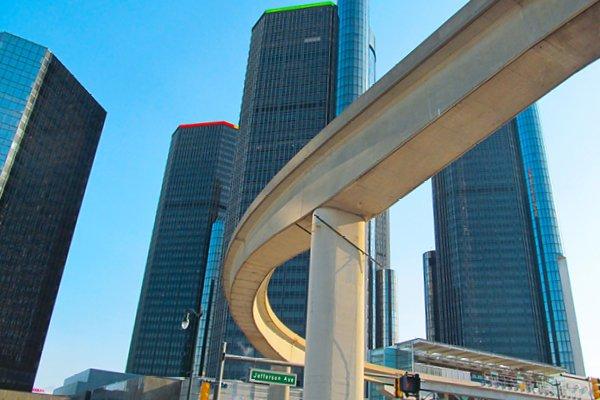
If you don't believe that a building can change your perception of safety, you need only look to the Renaissance Center, the Darth Vader of urban redevelopment. When it opened in 1977, it was supposed to spark a downtown renewal. But you don't ignite a renaissance with a dark castle of bewildering circles barriered behind a concrete HVAC system. The RenCen screamed, "Detroit is scary! Quick! Run inside so that we can pull up the drawbridge!" That's because the RenCen violates some basic tenets of CPTED, according to Detroit architect Rainy Hamilton. "The RenCen pushed people away both from the internal and external perspectives," he says. "From the outside, you couldn't see in and from the inside, you couldn't see out."
CPTED 101 is that you must have clear sightlines – people feel safer when they can scan the environment and see a threat coming. That was impossible with the RenCen's giant, cement HVAC berm blocking the view from Jefferson Avenue. Even from Detroit's main street, the building was hidden and impenetrable. "What General Motors has done with the building is to create front doors," Hamilton says of the 2004 building remodel, which added two wide-open entrances, one facing Jefferson Avenue and one on Atwater facing the Detroit River. "That creates a higher degree of safety because it's more inviting."
Another fear-reducing design principle is traffic, as in lots and lots of people. Crime thrives in places that are isolated and deserted. CPTED encourages as many "eyes" on the space as possible, helping the area to police itself. One of the scariest places in Detroit used to be downtown at 5:30 p.m. on weekdays. As soon as the office buildings emptied out, it was a ghost town. Now, with the revitalization of Campus Martius, the higher occupancy rate of office buildings, more residential units and the never-ending string of festivals (even in the winter!), downtown is no longer a place you flee before the clock dings 6 p.m. There are people! There are vendors! There is music and food and entertainment! Downtown was always relatively safe, but now it feels safe.
Hamilton is taking on another scary design feature that is a Detroit staple: the alley. Alleys in Detroit have become problematic, largely ignored and decrepit spaces that are a breeding ground for crime and neglect. Why? Because nobody is watching the alleys. In his new Brush Park development, City Modern, Hamilton says that problem will be solved. "We are pedestrianizing alleys to be a space where people can walk or bike," he says. "By turning alleys into public spaces, we are putting more eyes on the street."
We see CPTED at play all over the city. For decades, Detroit's office buildings were built with exclusivity in mind: You could only get in if you could get past security. Now, new and redeveloped buildings have street access to ground floor shops (think Royal Oak). Green spaces encourage people to linger and mingle. Infill projects and residential units create density, another tool for lowering the perception of crime. New York may have crime, but the crowded streets make you feel the safety in numbers. As Hamilton warns, there's still no substitute for good policing and quick response times. But while law enforcement works on actually reducing crime, Detroit's place-makers are doing their part to reduce the fear of it.
Every question deserves a better answer than a search result — here's where this story leads.

Why Every Metro Detroit Nonprofit Should Be Thinking About AI
How a local workshop is helping nonprofit leaders turn curiosity into practical action. For many nonprofit leaders, artificial intelligence still feels like something meant for Silicon Valley or Fortune 500 companies. It isn’t. Whether your organization has three employees or three hundred, AI is quickly becoming another tool that can help teams spend less time […]

Althea Gibson’s Second Act
Most people remember Althea Gibson as a tennis legend. Fewer know she also became the first Black woman to compete on the LPGA Tour, breaking another barrier and opening doors for generations of Black women golfers.

Detroit Jazz Festival 2026 Guide
A local guide to navigating the Detroit Labor Day weekend jazz celebration.
Help Us Get It Right
This coverage is a community project.
Spot something outdated? Know a person, business, or organization this story should connect to? A story we should tell next? It goes straight to our editors — privately.