
News + Features
Closing the Black-Jewish Divide in Detroit
February 7, 2017·By BLAC Editorial
Fifty years after 1967, it’s time to reach across suburban borders
February 7, 2017
n the mid-20th century, Detroit’s black and Jewish communities were in close quarters. During those times, Jews were still considered non-whites and were discriminated against along with the black community.
“They were part of the city’s entrepreneurial class, but they were relegated, in most instances, to the least desirable areas because whites discriminated against them just as they did blacks,” historian and artist Marsha Music says. “Jewish businesses were founded around Hastings Street and Black Bottom to a very large degree, in the same areas where blacks were. They had businesses on the same streets, they serviced the same community.”
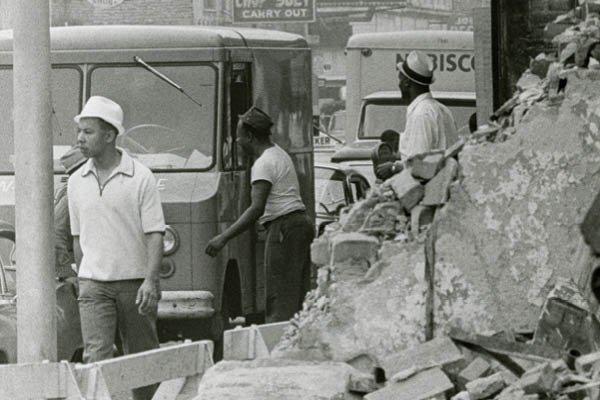
The events of 1967 left many businesses destroyed – both Jewish- and black-owned. However, many of the Jewish businesses owners were able to relocate their businesses to neighboring suburbs.
“On 12th Street, Linwood, Dexter – virtually all of those commercial areas on those main arteries were destroyed,” Music says. “Many of them would have taken much more to rebuild than what individual business owners had.”
Around that time, says Eleanor Gamalski, a community organizer for Detroit Jews for Justice, “(Jews) gained the label of ‘whiteness’ and the privileges that come with whiteness – and, at the same time, became more distant from the city and from labor organizing and from a genuine participation in spiritual life.
“There was also a distancing from the black community.”
Detroit Jews for Justice is an organization that mobilizes Jews in the city and suburbs for movements for racial and economic justice. She says as Jews began to join the white community in the suburbs, they also absorbed the narrative that the ’67 riots “ruined” Detroit and that a rich life in Detroit was taken away from them because of it.
“I think everyone in the suburbs needs to have a more nuanced understanding of the disinvestment and police brutality and the housing crisis that lead to the rebellion and the ways that those forces continued to damage the city,” Gamalski says. “The decline was not marked by the rebellion.”
DJJ, along with a few other Jewish organizations, are in the process of planning programming surrounding the 50th anniversary of 1967 rebellion. The group will be hosting panel discussions, going on 1967 bus tours led by the Black Scroll History Network and are also creating a downloadable guide to encourage Jewish families to have conversations about that time.
Music often speaks at Repair the World Detroit, a Jewish organization that connects young volunteers with service opportunities in the city.
“I want the younger people who are coming here to understand that they cannot come here with the same kind of gentrification attitudes that some of the young white kids come with,” Music says. “They need to understand that there is a real history that the Jews have with black people here. They are a part of Detroit’s legacy too.
“Learn from the mistakes of the past in order to forge some more sustainable unity between blacks and Jews here today.”
Every question deserves a better answer than a search result — here's where this story leads.

Why Every Metro Detroit Nonprofit Should Be Thinking About AI
How a local workshop is helping nonprofit leaders turn curiosity into practical action. For many nonprofit leaders, artificial intelligence still feels like something meant for Silicon Valley or Fortune 500 companies. It isn’t. Whether your organization has three employees or three hundred, AI is quickly becoming another tool that can help teams spend less time […]
Althea Gibson’s Second Act
Most people remember Althea Gibson as a tennis legend. Fewer know she also became the first Black woman to compete on the LPGA Tour, breaking another barrier and opening doors for generations of Black women golfers.

Detroit Jazz Festival 2026 Guide
A local guide to navigating the Detroit Labor Day weekend jazz celebration.
Help Us Get It Right
This coverage is a community project.
Spot something outdated? Know a person, business, or organization this story should connect to? A story we should tell next? It goes straight to our editors — privately.