People + Places
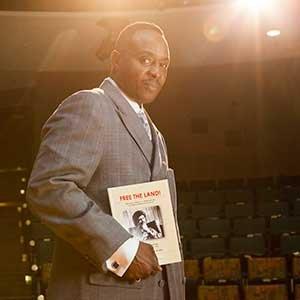
Charles Ezra Ferrell, Founder of the Liberation Film Series
February 5, 2015·By BLAC Editorial
For three years, this series at the Charles H. Wright Museum in Detroit brings the community together to watch and discuss educational films and history
February 5, 2015
Content brought to you by Ford Motor Company Fund
n 2011, Charles Ezra Ferrell helped the Charles H. Wright Museum of African American History create a program for Malcolm X Day. The event, Ferrell recalls, had “significant community turnout.”
The success sparked a new educational program at the Detroit museum: the Liberation Film Series.
Ferrell, who majored in political science and Black studies-and also studied history, sociology and psychology at Amherst College in Massachusetts and the University of Michigan-Dearborn-was approached with thoughts on other programs. His idea? Showing “films of significance for the community.” The films would be chosen based on the season’s overall defining theme, with each showcasing various subjects of cultural importance.
The Liberation Film Series, now in its third season, is much more than just the showing of a documentary. It also opens opportunity for conversation-and, as its webpage introduction emphasizes, “promotes literacy, independent thought, critical analysis and informed activism.”
“All too often people go to (a) film and leave,” Ferrell explains. But with LFS, there is additional information to read and watch on the film series’ website that filmgoers are encouraged to explore beforehand. And viewings are followed by a discussion with a speaker knowledgeable on the film’s subject.
“I think what we bring is a high caliber of speakers,” Ferrell says, “university professors, activists who have been on the front line-so they really can speak from an informed perspective in a comfortable setting.”
There’s usually a slideshow running as attendees enter the theater, and sometimes there are special additions. The series’ tribute to activist and labor leader General Gordon Baker Jr. in September 2014 opened with African drumming, he notes.
A focus on human rights at the Charles H. Wright Museum's Liberation Film Series
This season, LFS’ theme is “Human Rights: Self-Respect, Self-Defense, Self-Determination.” Says Ferrell, “We’re featuring a number of major people in history that are not typically covered in traditional education institutions.”
Something Ferrell says he hopes participants do with the information they learn through LFS? “That they become a catalyst for their own educational study. Because what we cover in the film series in a matter of hours should whet the appetite for digging deeper, for broadening their knowledge base and then sharing that with others.”
The LFS page, housed on the Charles H. Wright Museum’s website, lists high praise from scholars and others, along with supporters like the Black and African studies departments of various colleges and universities. The series has grown since its launch. LFS created a softback book for the Chokwe Lumumba tribute, and produced its own documentary, Raz Baaba Aaron Ibn Pori Pitts: Portraits of a Revolutionary Artist, which premiered at the beginning of the 2014-15 season.
“It was really a community effort to bring forth this documentary,” Ferrell says. The museum has also started recording the discussions to keep in its archives. “I’m very pleased and excited that the museum has allowed me a venue so that we can document history.”
The theme for the third season of the Liberation Film Series, running September 2014-June 2015, is “Human Rights: Self-Respect, Self-Defense, Self-Determination.” The season thus far has included tributes to General Gordon Baker Jr. and Chokwe Lumumba and has featured the LFS-produced documentary on artist Raz Baaba Aaron Ibn Pori Pitts as well as the independent documentary Our Generation: Australian Racism and The Indigenous Struggle for Human Rights and Self-Determination.
From 2 to 6 p.m. Feb. 21, see Free Angela and All Political Prisoners. The discussion to follow, titled “My Life as a Black Panther and Political Prisoner,” will feature Dr. Ahmad Rahman, associate professor of African and African-American history at the University of Michigan-Dearborn.
Films are shown in the General Motors Theater at the Charles H. Wright Museum of African American History located at 315 E. Warren Ave., Detroit.
The LFS films and discussions are free and open to the public. For more information on the series and this season’s films, visit TheWright.org.
Every question deserves a better answer than a search result — here's where this story leads.

Why Every Metro Detroit Nonprofit Should Be Thinking About AI
How a local workshop is helping nonprofit leaders turn curiosity into practical action. For many nonprofit leaders, artificial intelligence still feels like something meant for Silicon Valley or Fortune 500 companies. It isn’t. Whether your organization has three employees or three hundred, AI is quickly becoming another tool that can help teams spend less time […]

Althea Gibson’s Second Act
Most people remember Althea Gibson as a tennis legend. Fewer know she also became the first Black woman to compete on the LPGA Tour, breaking another barrier and opening doors for generations of Black women golfers.

Detroit Jazz Festival 2026 Guide
A local guide to navigating the Detroit Labor Day weekend jazz celebration.
Help Us Get It Right
This coverage is a community project.
Spot something outdated? Know a person, business, or organization this story should connect to? A story we should tell next? It goes straight to our editors — privately.