
News + Features
Black Lives Matter Detroit members await trials after arrests
September 5, 2016·By BLAC Editorial
Representatives say the long-term goal is to pressure the Detroit Police Department to fire Joseph Weekley, the Detroit Police officer who shot Aiyana Stanley-Jones.
September 5, 2016
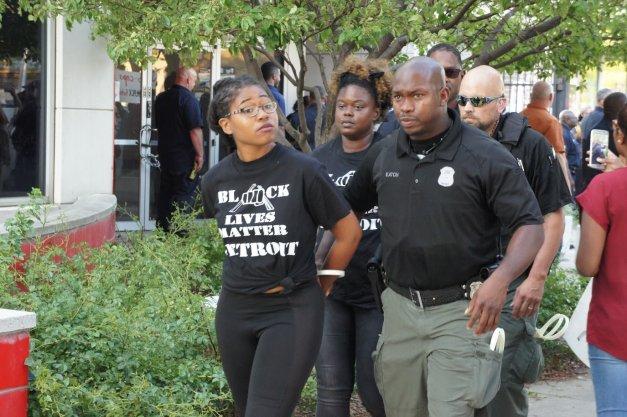
On July 20, Black Lives Matter Detroit and Black Youth Project 100 joined together and marched from Pallister Avenue to West Grand Boulevard to demand justice for Aiyana Stanley-Jones, who was killed at the hands of Detroit Police Department back in 2010.
During the protest in front of the 3rd Precinct on West Grand Boulevard, six members of both BYP 100 and BLM Detroit were arrested and charged for chaining themselves to a gate in front of the police department.
Weeks later, what we know now is the six arrested were released on personal bonds raised through a crowd-funding campaign. Two of the six have been arraigned and are currently awaiting pre-trials. The status of the remaining members is unknown at press time.
The hearings will be held at 36th District Court throughout late summer. Each member will go in front of a different judge that will determine their fates.
Black Lives Matter Detroit activist and minister Andre Gilford says the long-term goal of the protest is to pressure the Detroit Police Department to fire Joseph Weekley, the Detroit Police officer who shot Aiyana.
“For us, this action was apart of a long-term strategy and long-term campaign around violence against women and black femmes that was a national call,” Gilford tells BLAC. “But also, this is a part of bringing awareness to the fact that Detroit does have issues when it comes to the police and violence with the police.”
“Too often we think of ourselves as exceptional, that we don’t have problems with the police or our police are good partners in the community and that’s not the case,” Gilford adds.
Black Lives Matter Detroit was founded in 2014 and led by Isis Appling-Smith with the initial goal in mind to fighting against issues directly affecting the black community such as water shutoffs, food deserts, police brutality and discrimination. The Detroit chapter is a branch of the BLM national network and operates from the same framework as the national agency.
BLM Detroit consists of about 50 members stemming from diverse backgrounds, lifestyles and mindsets. Gilford says they believe it is important to represent and fight for all individuals in the black community and not just cisheterosexual black men, but also black women, the trans black community and black children.
“We have a focus on the folks who’ve been denied access to things within our community,” Gilford says. “We talk a lot about the violence against women and about violence against trans women and trans folk. We talk a lot about the children and the educational system that is disproportionately affecting the black children. These are issue that are important within our community.”
For more information about Black Lives Matter Detroit chapter visit, blmdetroit.wordpress.com.
Every question deserves a better answer than a search result — here's where this story leads.

Why Every Metro Detroit Nonprofit Should Be Thinking About AI
How a local workshop is helping nonprofit leaders turn curiosity into practical action. For many nonprofit leaders, artificial intelligence still feels like something meant for Silicon Valley or Fortune 500 companies. It isn’t. Whether your organization has three employees or three hundred, AI is quickly becoming another tool that can help teams spend less time […]

Althea Gibson’s Second Act
Most people remember Althea Gibson as a tennis legend. Fewer know she also became the first Black woman to compete on the LPGA Tour, breaking another barrier and opening doors for generations of Black women golfers.

Detroit Jazz Festival 2026 Guide
A local guide to navigating the Detroit Labor Day weekend jazz celebration.
Help Us Get It Right
This coverage is a community project.
Spot something outdated? Know a person, business, or organization this story should connect to? A story we should tell next? It goes straight to our editors — privately.