
News + Features
Amid Detroit’s latest renaissance, Highland Park wants in on the action
January 6, 2017·By BLAC Editorial
Mayor Hubert Yopp shares his big ambitions with BLAC on returning the city to excellence
January 6, 2017
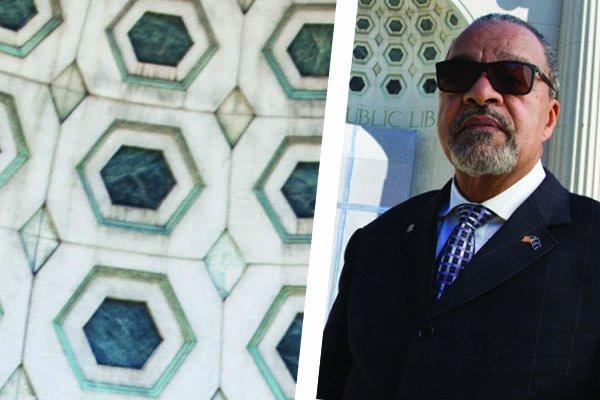
here may be no other building in Highland Park more reflective of the city than its own city hall. A small building on Woodward Avenue on the city’s southern border, it could use some work. Perhaps start with a deep cleaning, replace missing tiles, a fresh coat of paint, update the fixtures, replace the aging office furniture with something more contemporary. And adding more people would most certainly help.
The potential is there, but the costs of rebuilding and staffing is something the city doesn’t have. That’s been the running theme of Highland Park for years, and Mayor Hubert Yopp knows.
Yopp is now entering the second year of his second term – he was re-elected to the post for a second, non-consecutive term in January 2016. The first year was all about tying up loose ends from the previous administration and putting things in place for the rest of his term. This year, Yopp hopes, will be about bringing things to fruition.
During a series of conversations with BLAC at city hall, Yopp mentions no less than a dozen meetings with developers, state officials, fellow politicians and, of course, residents, to chart a course for this troubled city, which has teetered on the edge of ruin since, well, as long as many residents can remember. Many Highland Park residents have lived in the fear of the city failing longer than the city has been fully functional: Before the Sears closed, before Chrysler moved its world headquarters from Highland Park to Auburn Hills in the early 1990s, before arsons ripped through the city regularly, before an emergency manager took over in 2001 (and again in 2009), before the streetlights were repossessed in 2011 and before the century-old public school system closed its doors the next year.
Against all this, Yopp is optimistic, if cautious. “Highland Park is a city that’s struggling, but we’re not going to give up. We’ve got a good staff and we’ve got people that are interested,” he says. “We’re en route to recovery and returning Highland Park to excellence.”
Yopp’s vision of a Highland Park renaissance hinges on two key factors: Interest from developers and being treated fairly by the city of Detroit, Wayne County and the State of Michigan. Getting both in tandem is his challenge.
Getting what’s owed
Yopp, a lifelong Highland Parker, first was elected to office in 2008. A re-election bid failed in 2012 because during his first term, he says, he lost public faith when he made the difficult decision of allowing DTE Energy to repossess hundreds of streetlights after the city was unable to pay the utility company overdue debts owed.
“We had a $95,000-a-month light bill when I was mayor before,” he says. “I took it down to $15,000 – an affordable light bill. If I had left it at $95,000, we would have had to shut the doors.”
“Shut the doors” is, of course, bankruptcy for the city of Highland Park, something the city has avoided but come perilously close to. Left in the dark, residents instead voted in DeAndre Windom, who served from 2012 to 2016.
Yopp is careful not to disparage Windom, but does say that under Windom’s leadership, Highland Park lost what perhaps was its last significant asset: Its water department. Unlike many other municipalities in metro Detroit, Highland Park had an independent water authority that pumped in water from Lake St. Clair and only used the Detroit Water and Sewerage Department for sewage treatment. When DWSD began cracking down on overdue bills during Detroit’s bankruptcy, Highland Park came up short and was forced to shutter its water department and switch to the Great Lakes Water Authority, which began overseeing DWSD in 2016.
“The bad thing about that is, for our residents, we have no say in setting the rates,” Yopp says, noting that when Highland Park had its own water department, it indeed set its own prices for customers.
That’s not all. Yopp says Highland Park’s water department set its water system mains at 40 PSI, but GLWA’s runs between 30-35 PSI in the city. That’s a problem when it comes to attracting development, he says – most insurers ask for 40 PSI in commercial districts.
Reopening the water department can be done, Yopp says, with an infusion of cash he believes is due to Highland Park from the State of Michigan.
“The state owes Highland Park about $28 million,” Yopp says, a figure that has come up frequently in reports as the city tussles with the entities around it.
It’s long been argued that the Michigan Department of Transportation owes the mighty sum to the city because of a stormwater runoff treatment fiasco that has gone back 30 years. MDOT, Yopp says, handles drainage of stormwater along Woodward Avenue and other state roads but has relieved the costs of nearly every municipality along Woodward except Highland Park.
With the reimbursement from the state, Yopp says the city can re-open the water department and maybe make headway with Highland Park’s other woes. The city has received $1 million in federal funds to knock out blight, “but that’s not nearly enough,” he says, citing the rising costs of demolition and a mandate to cover empty lots with new dirt. “It’s expensive; that’s a whole process,” he says, pointing to recent reports of the Detroit Land Bank Authority’s constant federal oversight.
Yopp’s other looming priority is figuring out a way for the city to bring back a healthy school system. Though the mayor’s office and the public school district have long been separate, Yopp says he wants to involve more residents in the process of choosing the best school for their children – be it a brand-new public district or more charter operations like the ones currently operating the city’s last elementary and middle schools.
“I’ve sat through two proposals, and I don’t think it should be left upon the politicians,” Yopp says. “I think it should be a survey sent to citizens.
“I wouldn’t buy a home in Highland Park and bus my children 20 miles away, so I’ve got to make sure the school system in Highland Park is what I want for my children – and so I think the survey should be done with the community.”
Appropriate development
In the 2010 Census, Highland Park was estimated to have nearly 12,000 residents. Yopp estimates it currently stands at about 8,000. Many of those, he says, are seniors.
“The people have been here a long time. They’re seniors, and they get fixed income,” he says. “Anytime you tack on something, they have to give up something. Bottle of pills. Gallon of gas, whatever. And so we try to consider that. When you talk about increasing the cost of anything, it’s difficult – but, you know, sitting in this chair, you have to think about those people. Fortunately, I’m from the city. I know what they’re going through.”
It’s why he’s cautious about development in the city. There has been interest, he says, but the administration is carefully vetting each potential developer to ensure they can financially back up their plans.
Two once-exciting developments have lost steam. One is the plan to turn the old Model T plant on Woodward – arguably the city’s centerpiece, considering the Ford Motor Company’s history with Highland Park – into a museum, which Yopp says is out of his control. “That’s owned by the Woodward Avenue Action Committee,” he says, which is moving “not as fast as I would like.”
The other was 2014’s splashy announcement that the Brooklyn, N.Y.-based Galapagos Art Space would be relocating to Detroit – including moving part of its operations to the old Highland Park High School and three other properties in town. That, too, remains at a standstill, and Yopp says he has not been in contact with any Galapagos representatives recently.
The mayor has his own wishes. “I’d like to see a nice restaurant and a movie theater,” he says. Because of the aging population, he is frankly hesitant about too-trendy development like bars and microbreweries; “It brings about unwanted trouble,” he says. (For example, a proposal to revamp the long-vacant McGregor Public Library into a microbrewery was rejected, he says.)
“I’m concerned about developing housing, a school system, a library and businesses on Woodward,” he says. He looks to Royal Oak, which Woodward also cuts through, as an example. “Main Street is gorgeous, I like it. You can go up there in the summertime and sit outside. Royal Oak is a beautiful city.”
Nothing is promised, Yopp says, but if nothing else, he’s hoping to get new Highland Park residents on the ground floor so they’ll be here when – if – the development comes.
“If you notice, the development is pushing north. We have the light rail (in downtown Detroit) now,” he says. “You see the growth pushing north and see houses going for 50-grand apiece, 100-grand apiece – but you want to get one now in Highland Park for $15,000.”
AARON FOLEY IS EDITOR OF BLAC DETROIT.
Every question deserves a better answer than a search result — here's where this story leads.

Why Every Metro Detroit Nonprofit Should Be Thinking About AI
How a local workshop is helping nonprofit leaders turn curiosity into practical action. For many nonprofit leaders, artificial intelligence still feels like something meant for Silicon Valley or Fortune 500 companies. It isn’t. Whether your organization has three employees or three hundred, AI is quickly becoming another tool that can help teams spend less time […]

Althea Gibson’s Second Act
Most people remember Althea Gibson as a tennis legend. Fewer know she also became the first Black woman to compete on the LPGA Tour, breaking another barrier and opening doors for generations of Black women golfers.

Detroit Jazz Festival 2026 Guide
A local guide to navigating the Detroit Labor Day weekend jazz celebration.
Help Us Get It Right
This coverage is a community project.
Spot something outdated? Know a person, business, or organization this story should connect to? A story we should tell next? It goes straight to our editors — privately.