
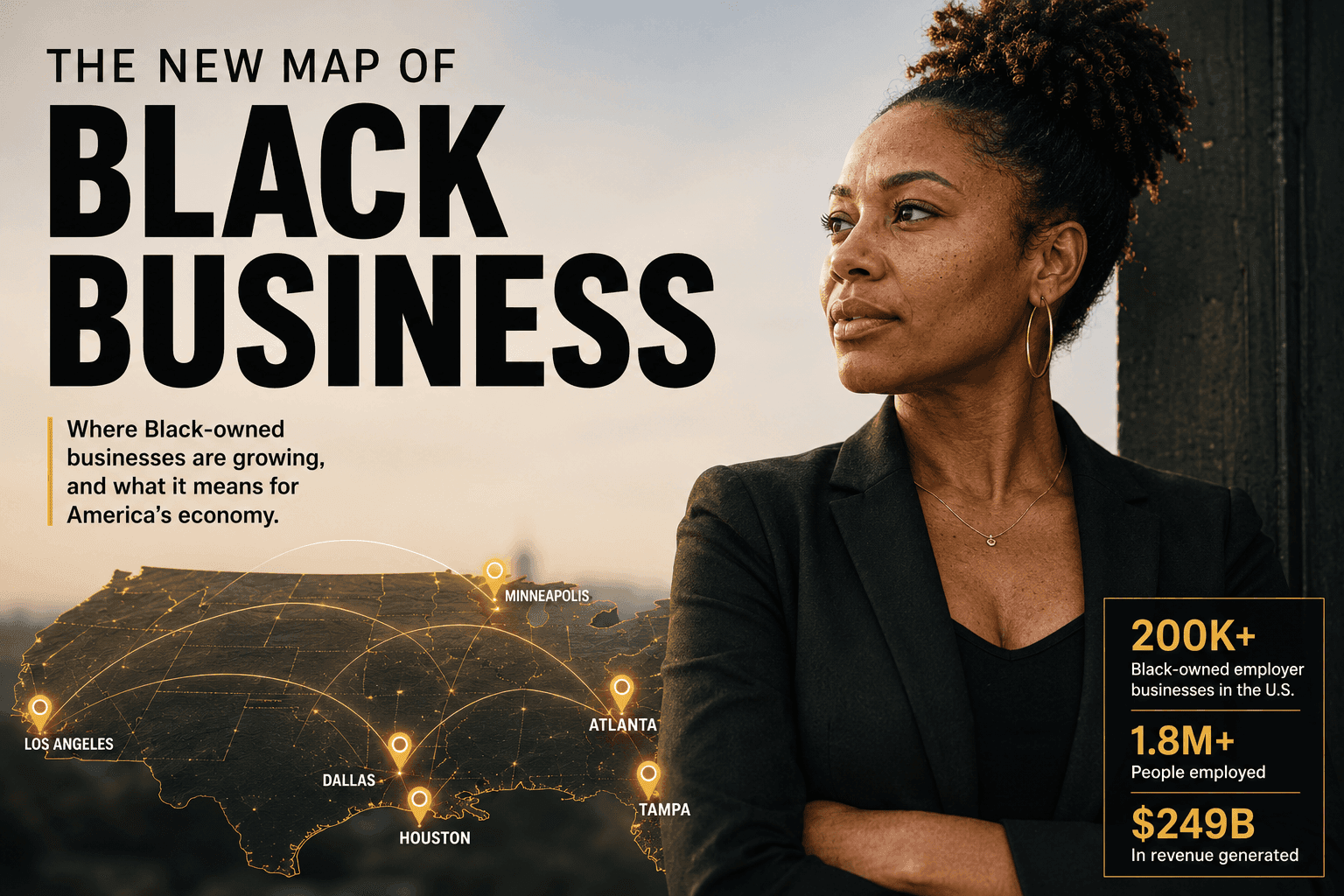

Black-owned businesses are growing across America.
But where that growth is happening may be just as important as the national number.
In 2023, the number of Black-owned employer businesses in the United States surpassed 200,000 for the first time. Those companies generated $249 billion in revenue, employed more than 1.8 million people and paid nearly $70 billion in salaries.
That is not a small-business footnote.
It is an economic story.
And when you look city by city, another story starts to appear.
Black business growth is not happening in one place. But it is not happening evenly, either.
First, a Word About What We’re Counting
There are millions of Black entrepreneurs in the United States.
The numbers here are narrower.
The Census Bureau’s Annual Business Survey tracks employer firms, meaning businesses with paid employees. For ownership to be classified as Black-owned, Black owners generally must hold at least 51% of the company’s stock or equity.
That distinction matters.
A freelancer running a business alone and a company employing 25 people are both entrepreneurs, but they play different roles in the economy.
This story is about the second group: Black-owned companies that have crossed the line from creating a job for the owner to creating jobs for other people.
And that group is getting larger.
Between 2017 and 2023, the number of Black-owned employer firms grew 62%, adding nearly 77,000 businesses. Over that same period, the total number of U.S. employer businesses grew just 3.3%.
That is a substantial difference.
BLAC DATA
Where Black-owned businesses are growing
Black-owned employer firms grew 62% nationally from 2017 to 2023. The largest gains are concentrated in major metros, while some smaller-base markets are growing much faster.
Atlanta Added More. Minneapolis Grew Faster.
Atlanta remains impossible to ignore.
Between 2017 and 2023, the metro area added roughly 6,000 Black-owned employer businesses, the largest numerical increase in the country.
Miami added about 4,700. New York added approximately 3,800. Washington, D.C., gained roughly 3,600, while Los Angeles added more than 3,500.
Those are the scale stories.
But scale is only one way to read the map.
Smaller Black business ecosystems sometimes posted far greater percentage gains.
Flint, Michigan, for example, added 205 Black-owned employer firms from 2017 to 2023. That is nowhere near Atlanta’s raw number, but for Flint it represented 159% growth.
Minneapolis offers another version of that story. Its growth from a much smaller starting point has made it one of the country’s most notable emerging markets for Black-owned businesses.
Atlanta tells us where the numbers are big. Places like Minneapolis and Flint tell us where something may be changing.
That is why a ranking based only on the total number of businesses can miss part of the story.
A city adding 500 Black-owned businesses to an ecosystem of 10,000 is different from a city adding 500 to an ecosystem that previously had 300.
Both matter.
They tell us different things.
The South Keeps Showing Up
There is also a clear regional pattern.
Many of the metros with some of the strongest Black business representation are in the South.
Brookings found that 60% of the 50 metro areas with the largest shares of Black employer-business ownership were located in Southern states. Among the 90 metros with the smallest shares, only 18% were in the South.
That includes places we might expect, such as Atlanta and Houston.
But it also includes markets such as Tampa, Richmond, Durham and Austin, where Black-owned employer businesses have shown significant recent growth.
Houston is particularly worth watching.
From 2022 to 2023 alone, Houston added 902 Black-owned employer businesses, the largest one-year increase of any metro in the country. New York added 843 and Miami added 736.
Houston’s increase was enough for it to move ahead of Dallas in the total number of Black-owned employer businesses.
That is not simply a story about Houston.
It is another signal that Black enterprise is becoming an increasingly important part of the economic identity of growing Southern metros.
Growth Does Not Mean Parity
The numbers are encouraging.
They are not evidence that the gap has closed.
Black Americans represented about 14.4% of the U.S. population in 2023.
Black entrepreneurs owned just 3.4% of employer businesses.
That difference is enormous.
More Black businesses exist than six years ago. Black business ownership is still nowhere close to reflecting the size of Black America.
Those two things can be true at the same time.
The growth should be recognized.
The gap should not be hidden by it.
Brookings estimates that if Black employer ownership across Southern metropolitan areas alone reached parity with the Black share of those populations, the result could mean more than 2 million additional jobs, about $70 billion in payroll and more than $263 billion in additional revenue.
That makes the ownership gap something larger than a diversity statistic.
It represents economic activity that does not yet exist.
What Kind of Businesses Are Growing?
Black-owned employer firms are not spread evenly across industries either.
About half are concentrated in five broad areas, including health care and social assistance, professional and technical services, administrative and support services, and related service industries.
Health care is especially significant.
Black workers, particularly Black women, are heavily represented in health care jobs. Black ownership within the industry has grown as well.
But Black people still account for only about 7.7% of employer businesses in health-related industries despite representing more than 14% of the population.
Transportation tells a somewhat different story.
Black entrepreneurs own about 13.7% of employer firms in transit and ground passenger transportation, putting ownership in that sector much closer to Black representation in the population.
At the other end are sectors such as machinery manufacturing and fabricated metal manufacturing, where Black ownership remains below 1%.
The opportunity, then, is not simply to create more Black businesses.
It is also to broaden where Black ownership exists.
Black Women Are Driving a Significant Part of the Increase
One of the strongest trends inside the larger numbers is the growth of Black women-owned employer businesses.
There were fewer than 45,000 Black women-owned employer businesses in 2017.
By 2023, there were approximately 79,000.
That represents growth of roughly 78% in six years, faster than Black employer businesses overall.
That growth is occurring despite persistent barriers to capital.
Brookings notes that Black women business owners experience business-loan rejection rates substantially higher than white business owners, with many financing their companies with their own money.
Black women are not simply starting businesses. Increasingly, they are building businesses that employ other people.
That distinction deserves more attention.
The Growth Is Real. So Is the Fragility.
There is one more important piece of the data.
Growth is not a straight line.
Nationally, Black employer businesses grew only 3.2% from 2022 to 2023 after much faster growth in the preceding years.
Some of the metros with impressive six-year gains actually lost Black-owned businesses in the most recent year.
Atlanta, despite leading the country in long-term growth, lost more than 600 Black employer firms between 2022 and 2023.
Charlotte, Raleigh, San Francisco and Virginia Beach also experienced notable declines.
That does not erase what happened between 2017 and 2023.
It does remind us not to confuse momentum with permanence.
Businesses still need customers.
They still need capital.
They still need contracts, workers, infrastructure and room to scale.
And a city that celebrates Black entrepreneurs when they open but does little to help them survive has not really built a Black business ecosystem.
Watch the Map
The national number will continue to matter.
More than 200,000 Black-owned employer companies is a milestone worth recognizing.
But BLAC will be watching something else too.
Where are those businesses appearing?
Where are they surviving?
Where are they hiring?
Which cities are creating conditions where a Black-owned company can move beyond self-employment and become an employer?
And which places are losing ground?
Because the most interesting part of this story may not be that Black business is growing.
It may be what the map looks like five years from now.
Sources
- U.S. Census Bureau, Annual Business Survey (ABS) — National and metropolitan-area data on employer businesses by race and ethnicity, including firm counts, employment, payroll and revenue. The 2023 ABS is the underlying federal data source for the latest Black-owned employer-business figures used in this story.
- Brookings Institution, “Black Employers Are Reaching New Heights” — Andre M. Perry and Hannah Stephens, March 10, 2026. Analysis of 2017–2023 Census Annual Business Survey data, including national growth, metropolitan-area gains, industry representation and Black women-owned employer businesses.
- Brookings Institution, “The Shifting Landscape for Black-Owned Businesses: An Update to the Black Business Parity Dashboard” — Hannah Stephens and Andre M. Perry, June 15, 2026. Metro-level analysis of Black business ownership, representation, recent growth and the economic potential of closing local ownership gaps.
- Brookings Institution, Black Business Parity Dashboard — Interactive analysis using Census Annual Business Survey data to compare the share of Black-owned employer businesses with the Black population share in U.S. metropolitan areas and estimate potential gains in businesses, employment, payroll and revenue. Updated June 15, 2026.
- Brookings Institution, “Driving Prosperity: How Black-Owned Businesses Fueled Recent Economic Growth” — Earlier analysis of 2017–2022 Census data used for historical context and comparison with the latest 2023 figures.
Data note: Throughout this story, “Black-owned businesses” generally refers to Black-owned employer businesses, meaning firms with at least one paid employee. Metro growth figures and comparisons are based primarily on Brookings Metro analysis of U.S. Census Bureau Annual Business Survey data.
Filed under