
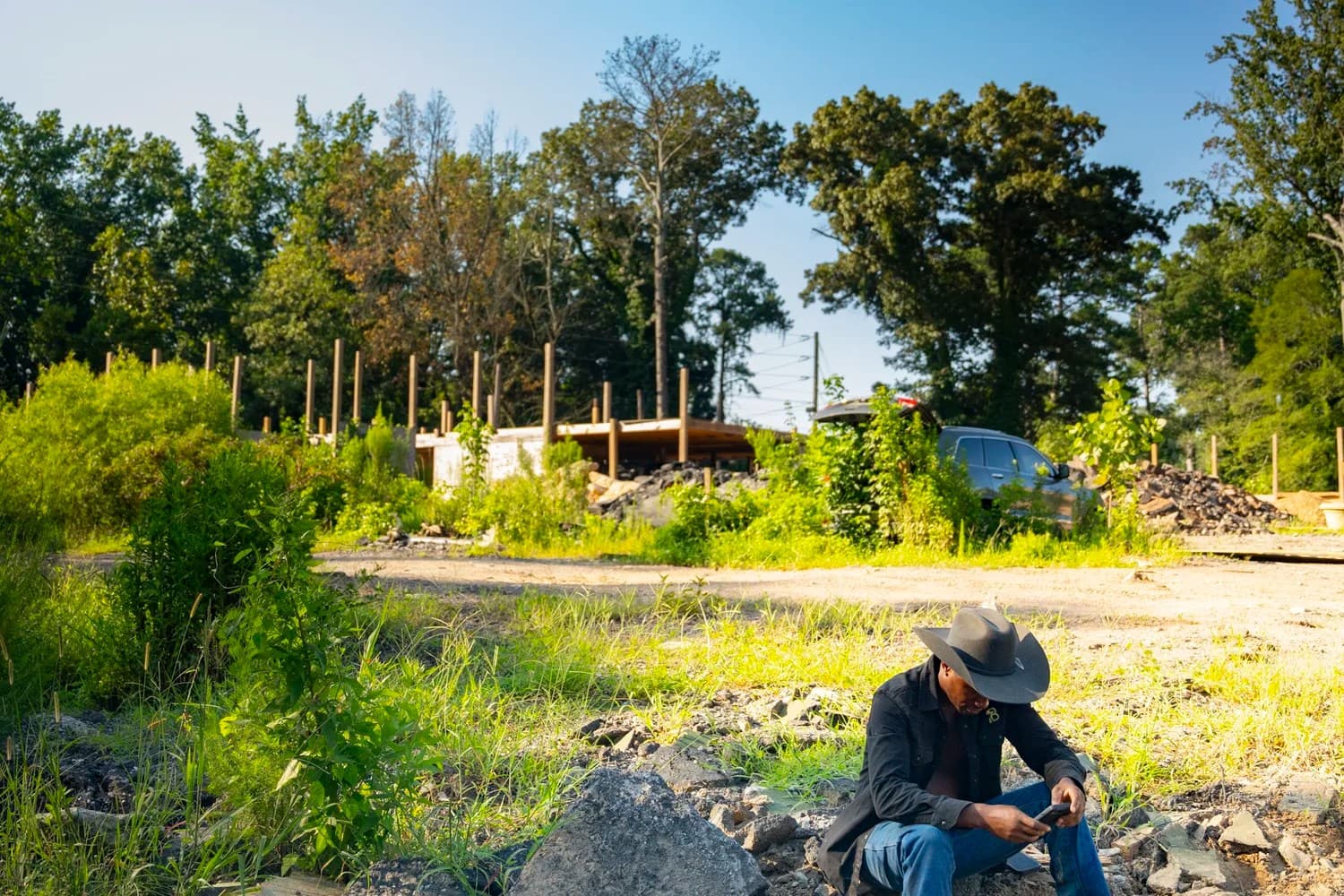

For Brandon Fulton, 27 acres in South Fulton hold several futures at once. He describes the land as a place for horses, but also as the ground for a community equestrian farm that could welcome young people and families. In his telling, equine therapy, riding, and rodeo programming belong to that imagined future, not to a venture already in operation. The distinction matters: what exists in the record is an intention, still being carried through a conflict that has not reached its legal end.
Fulton says he bought the acreage in 2016, rather than inheriting it, after growing up in Brownsville, Brooklyn. He remembers horses as an early family language: he says he began riding at six, alongside his grandfather at Jamaica Bay. Later, he says, he moved from touring as a music DJ into full-time horse work. Those biographical details rest on his own account, yet they clarify the continuity he draws between childhood, livelihood and the acreage he hopes to shape. The land, in that vision, is practical before it is grand.
The documentary *Brannu* stays close to that vision without resolving the dispute around it. Filmmaker Adelin Gasana says producer Julia Griggs met Fulton on the Atlanta BeltLine, and the team went on to film across two seasonal cycles over about two and a half years. Axios likewise reported that production lasted roughly that long and that the film screened at the Atlanta Documentary Film Festival. Time gives the project its weight: the camera can record persistence, change and uncertainty. It cannot, by its presence alone, prove any disputed allegation. Its duration offers proximity, but proximity is not the same as adjudication.
That uncertainty unfolds in a city whose recent identity is often described through scale and Black civic presence. The U.S. Census Bureau estimated South Fulton’s population at 112,820 on July 1, 2025, with a 90.6% Black-alone share. The numbers offer context, not a verdict on what any particular parcel should become. Fulton’s 27 acres sit within that larger regional story, where land may be shelter, work, inheritance or aspiration. His own account emphasizes purchase rather than inheritance, and a future meant to be shared. Here, questions about a parcel’s future move between private aspiration and public consequence as public agencies and courts enter the record.
The public stakes sharpen around events from 2016, but the later dismissal must remain clear. Capital B reported that Fulton bought the property near Butner and Camp Creek roads for $150,000 that year. It also reported that horses were seized and that charges followed. WSB-TV reported that the district attorney dismissed the felony animal-cruelty case against Fulton in 2018. According to Capital B, the horses were not returned and Fulton was not compensated. These are reported events, not a basis for inferring why officials acted.
For Fulton, the horses and acreage are intertwined parts of work and of a community plan he still describes in future terms. In his account, the acreage remains the intended setting for the equestrian programs he hopes to build for families and young people. The packet includes no responses from government entities, police, court parties or developers, and it offers no evidence establishing official or development motive. The documentary’s sustained attention can make the loss and hope visible together without settling those missing perspectives.
Fulton alleges that development pressure and official actions threatened his ability to retain and use the land. That is his allegation, not an established explanation for the seizure or the litigation that followed. The restraint is essential because *Brannu* is strongest as a record of what it accompanied: a horseman describing what he wants to build, seasons passing across acreage he associates with that future, and a dispute continuing beyond the film’s frame. Witnessing preserves experience. It does not convert one participant’s understanding into a finding about another’s intent.
The criminal case that WSB-TV said was dismissed in 2018 is distinct from the related civil litigation over the 2016 search and seizure. A three-judge Eleventh Circuit panel issued an opinion in 2025. But the court later granted rehearing en banc, vacating that panel opinion. It is therefore not current precedent or a final judgment. The procedural turn leaves the civil questions unresolved, even as the dismissed prosecution remains an important and separate part of Fulton’s history with the land and horses.
As of October 8, 2026, the Eleventh Circuit’s en banc case page listed oral argument for October 20. No outcome existed on the packet’s access date, and none can be anticipated here. That posture places *Brannu* in an unusual temporal space. The film has followed Fulton long enough to show the endurance of his stated plans, yet the legal record remains open. Its ending, whatever shape it takes, cannot supply the final word that the courts themselves had not reached.
What remains is Fulton’s intended future: horses on the acreage, young people and families finding room there, and a form of work connected to the riding life he traces back to his grandfather. None of that programming is presented as complete. Nor does the documentary settle whether the vision will be realized. Instead, its long gaze holds place, livelihood, community possibility and contested promise in the same frame. For now, the 27 acres remain both specific ground and an unfinished question: not what the land symbolizes, but what Fulton may yet be able to make of it. The record preserves his intention while leaving its prospects unsettled.
Sources and further reading
Filed under