
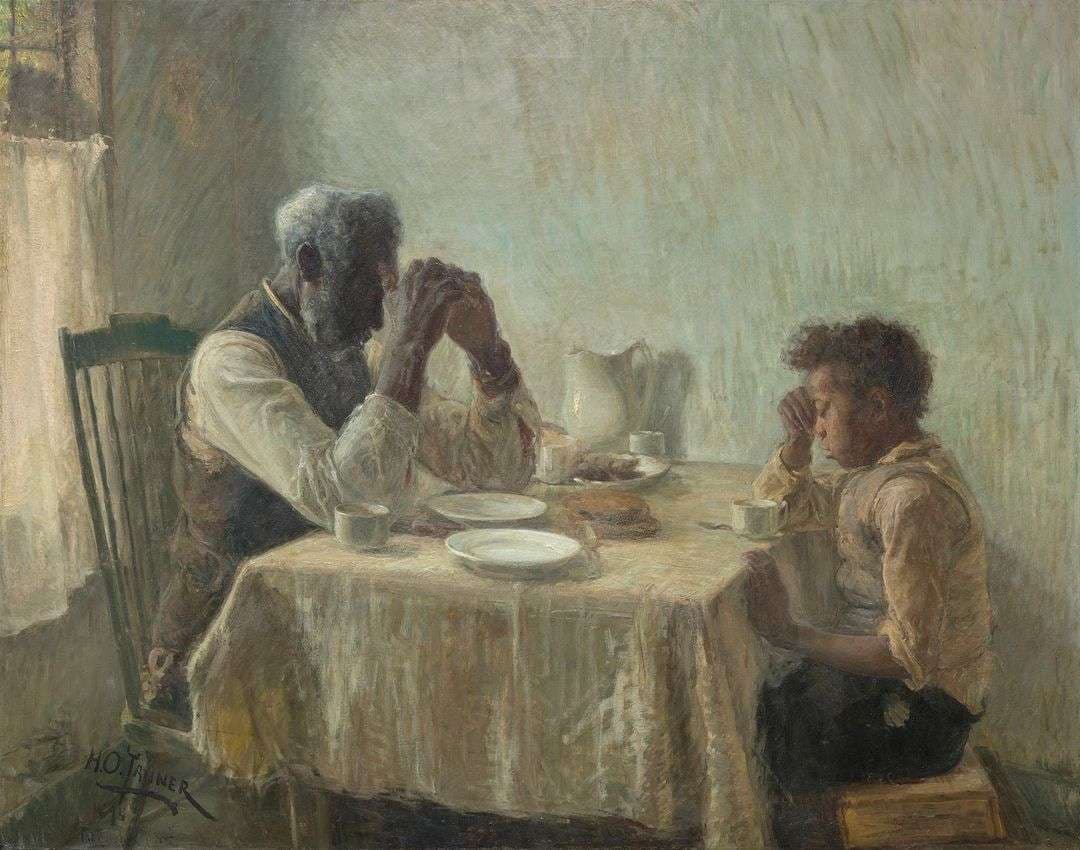

The recently conserved “The Thankful Poor” by Henry Ossawa Tanner, who is considered as the first Black American artist to receive international acclaim, is currently on display at the Memphis Brooks Museum of Art, now until February 2023.
The painting features a Black man and child sitting around a simple table in the middle of a prayer for a modest meal. The Thankful Poor portrays a vulnerable moment of the humanity of Black people which was in sharp contrast to the dehumanizing images of African Americans that was prevalent in American society in the late nineteenth century.
The oil on canvas is considered one of the artist’s last recognizable “genre” paintings that show commonplace or daily home settings before he shifted to purely religious-themed painting. The painting, according to the Brooks Museum, was intended by the artist to celebrate the accomplishments and sufferings of underprivileged Black people in the South where this piece was believed to have been created.

Tanner was considered the first African American painter to receive international recognition, according to the National Archives. He was born to an abolitionist mother who escaped slavery on the Underground Railroad and an African Methodist Episcopal bishop father in Pittsburgh, Pennsylvania. The Black artist first trained under renowned American Realist painter Thomas Eakins at the Pennsylvania Academy of Fine Arts, but then made the decision to go to Paris to enroll at the famous Académie Julian art school, in part to avoid the prejudice he encountered there, according to the Brooks Museum.
The painter was catapulted to fame during the last 10 years of his life which earned him a reputation as one of the most influential biblical painters of his era and as a major American artist in Paris. He visited numerous “Holy Land” countries during his lifetime, which includes Egypt, Morocco, and Palestine. These places have served as the inspiration for a number of his works in the latter half of his career. He had great success overseas, took part in several Paris salons beginning in 1874, and in 1927 was given the honorary title of chevalier (Knight) of the Order of the Legion of Honor of France, which is the highest award given by that country for excellence.
Filed under