
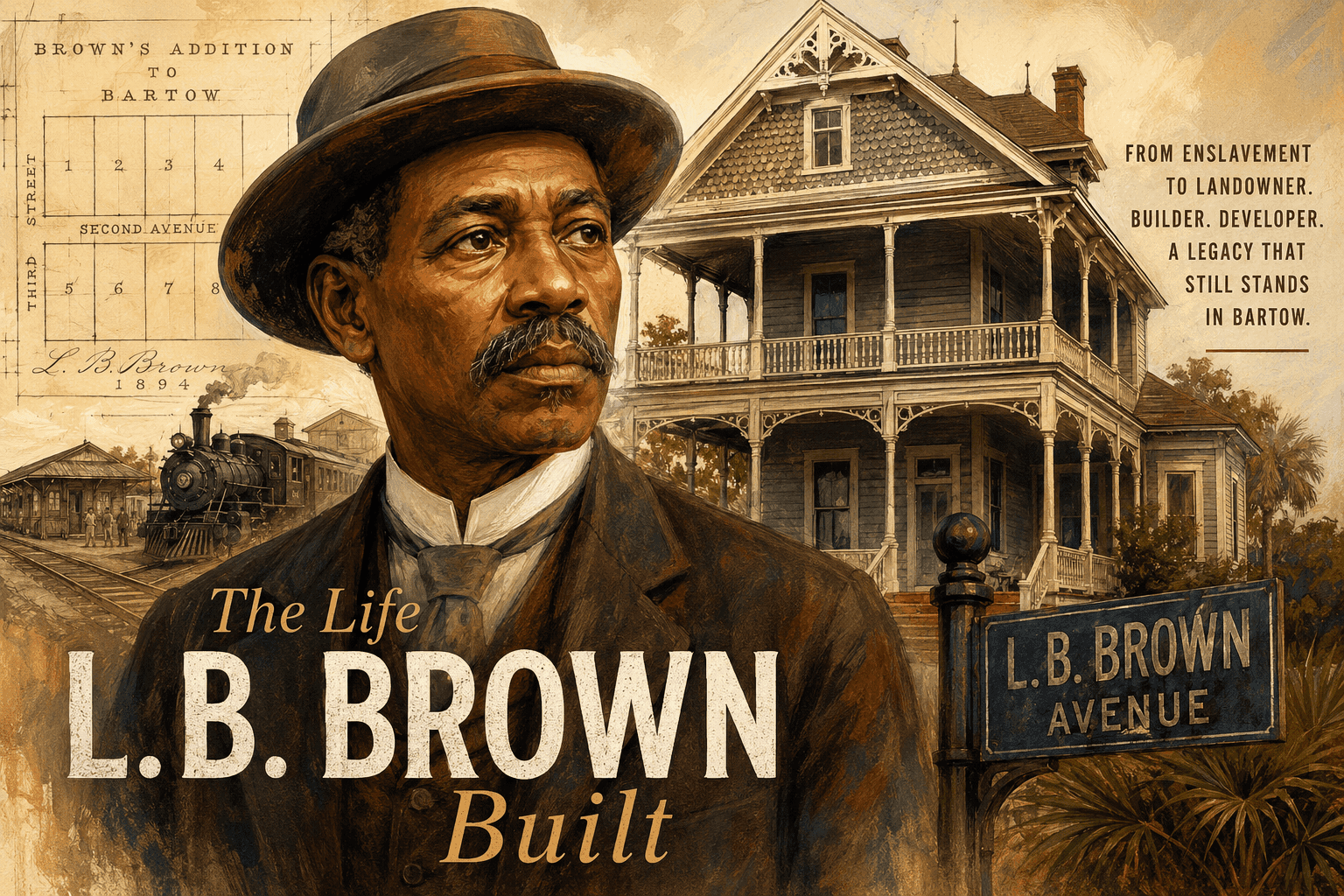

The house at 470 L.B. Brown Avenue in Bartow stands as more than an artifact of late-19th-century Florida architecture. Its two-story veranda, cross-gable form, patterned shingles and ornamental details tell part of the story. The man who built it tells the rest.
Lawrence B. Brown was born into slavery in Alachua County, survived the transformation that followed emancipation and eventually became a carpenter, builder, property owner and developer. By the time he established himself in Bartow, he was not simply constructing a home for his family. He was acquiring land, building houses and participating in the development of a Black community taking shape in a rapidly growing Florida town.
Today, the street once called Second Avenue carries his name. His home is listed on the National Register of Historic Places. A foundation stone from another house he built is held by the Smithsonian National Museum of African American History and Culture.
Taken together, those pieces make Brown’s story unusually tangible. His legacy can still be located on a map, approached from the street and, in the case of his house, seen standing where he put it more than 130 years ago.
Before Bartow
Even the beginning of Brown’s story contains an unresolved piece of history.
Florida Memory records his birth as Sept. 12, 1856. The National Register of Historic Places documentation gives the year as 1858. Both agree on the larger fact: Brown was born enslaved in Alachua County, the son of Peter Brown, identified as a minister, and Catherine Brown.
That means Brown was still a child when slavery ended in Florida in 1865. What followed would place him among the first generations of Black Floridians attempting to turn freedom into something material — land, property, skilled work and the ability to shape the communities in which they lived.
His property-owning life did not begin in Bartow.
Around 1882, Brown moved to Spring Garden in Volusia County. He and his wife, Elizabeth, acquired property and built a house there. Records documented in the National Register nomination show that Brown continued to hold property in Volusia County even after moving to Bartow, selling the final tract in 1910.
That detail adds an important layer to his story. Bartow did not create Brown’s interest in land ownership. He arrived with experience.
A Growing Town
Bartow itself was changing quickly.
Rail connections reached the community in 1885, during a period of rapid development. Its population increased from roughly 400 people in 1885 to 1,386 by 1890. Between 1883 and 1894, 41 subdivisions were created.
Black residents were part of that growth, helping establish East Bartow as the town expanded.
Brown relocated to Bartow sometime after the railroad connection had been established. The surviving record does not prove that the railroad caused his move, but the timing places him squarely within an important period in the city’s development.
Then came the transaction that would anchor his legacy there.
In May 1892, Brown purchased approximately two acres along Second Avenue from Louis N. Milam. He paid $155. The property sat near Main Street, the railroad and the passenger station, and National Register documentation identifies it as Brown’s first Bartow real-estate acquisition.
On that land, Brown built his home.
Completed in 1892, the residence was not merely a house Brown owned. National Register documentation identifies him as both its architect and builder. Its surviving features include the prominent veranda, decorative millwork, patterned shingles, leaded-glass elements and foundations incorporating tree-trunk piers.
Brown would live there until his death on June 16, 1941.
But the more consequential turn in the story came when his property became more than his own homesite.
From Landowner to Developer
In 1894, Brown subdivided his property.
Brown’s Addition consisted of eight lots along Second Avenue between Stanford and Wabash avenues, most measuring approximately 70 by 156 feet. With that act, the historical record becomes clearer about the scale of Brown’s ambitions.
He was not only practicing a trade. He was participating in the development of a neighborhood.
That distinction matters when considering Brown’s place in Bartow history. Carpentry gave him the ability to construct buildings, but property ownership and subdivision gave him a role in determining how land would be used and how part of East Bartow would develop.
The surviving records show that Brown went on to purchase additional lots in Bartow and build houses. His documented work is best described plainly: He was a carpenter, builder, property owner and developer.
There is no verified basis for attaching a formal construction-company name to his work, and no authoritative inventory has been found establishing precisely how many houses he built. Claims assigning him a specific total may make the story neater, but the surviving evidence supports something more useful than a neat number.
Brown left a footprint.
Evidence in Wood, Land and Stone
That footprint extends beyond his own residence.
One of the strongest surviving pieces of evidence is not in Bartow at all. The collection of the Smithsonian’s National Museum of African American History and Culture includes a foundation stone from a bungalow Brown built in East Bartow.
It is a modest object with considerable historical weight.
The stone independently connects Brown to construction beyond his own home and turns an occupation listed in records into something physical. Brown built elsewhere in the community, and a piece of that work entered the national collection in 2015.
Back in Bartow, Brown’s Addition offers another kind of evidence. A subdivision is not simply a building. It is an intervention in the landscape — a decision about parcels, ownership and the physical organization of a community.
For a man born enslaved in Florida, that progression carries its own historical force. Brown moved from being legally denied ownership of himself as a child to acquiring property, improving land and creating lots that became part of the geography of East Bartow.
The record does not require embellishment.
BLAC History • Bartow, Florida
The Life L.B. Brown Built
Born into slavery, Lawrence Bernard Brown became a builder, property owner and developer whose work helped shape East Bartow. Follow the record from his beginnings in North Florida to the house and community legacy that remain today.
Brown is born into slavery
Lawrence Bernard Brown was born in Alachua County, Florida, before emancipation.
Go deeper
The historical record contains a discrepancy. Florida Memory gives Brown’s birth as Sept. 12, 1856, while the National Register nomination gives 1858.
Freedom comes while Brown is still a child
The end of slavery places Brown’s childhood at the beginning of a radically different legal and economic era for Black Floridians.
Go deeper
Brown’s later property ownership and building career unfolded during the generations immediately following emancipation. The surviving records document what he built and owned; they should not be used to invent undocumented details about his childhood experience.
Brown becomes a property owner
Brown moved to Spring Garden in Volusia County, where records place him and his wife Elizabeth as property owners before his Bartow years.
Go deeper
Brown retained property in Volusia County even after relocating to Bartow. The last of those tracts was sold in 1910.
View the National Register nominationBartow is growing fast
Railroad connections reached Bartow in 1885 as the community entered a period of rapid population growth and subdivision development. Brown subsequently relocated there.
Go deeper
National Register research records approximately 41 subdivisions created in Bartow between 1883 and 1894. Brown’s later development activity belongs within that wider transformation.
$155 and two acres
Brown purchased approximately two acres on Second Avenue in Bartow from Louis N. Milam for $155.
Go deeper
The property was near Main Street, railroad tracks and a passenger station. National Register documentation identifies it as Brown’s first Bartow real-estate acquisition.
See the property historyBrown builds his Bartow home
Brown constructed the residence now known as the Lawrence Brown House. National Register documentation identifies him as both architect and builder.
Explore the house
Documented features include a two-story veranda, cross-gable form, patterned wood shingles, ornamental millwork, leaded-glass elements and foundations that incorporated tree-trunk piers.
Brown continued living in the house until his death in 1941.
Explore Florida Memory’s house recordOne property becomes eight lots
Brown subdivided his two-acre tract into Brown’s Addition, creating eight lots along Second Avenue.
Go deeper
Most of the lots were approximately 70 feet wide by 156 feet deep. The subdivision is significant evidence that Brown’s work extended beyond carpentry and homebuilding into land development.
Brown later acquired additional Bartow property and built houses elsewhere in the community.
View the Brown’s Addition documentationHis footprint expands through Bartow
Records document Brown purchasing additional lots and constructing houses as East Bartow developed.
What do we actually know?
Brown is documented as a carpenter, builder, property owner and developer. No authoritative complete inventory of his buildings has been located.
His property story still reaches back to Volusia
Brown sold the last property he continued to own in Volusia County, showing that his real-estate holdings had crossed county lines for years.
Go deeper
The overlap between Brown’s Volusia and Polk County holdings is part of the documentary evidence that his property activity began before his Bartow success.
Brown dies in the house he built
Lawrence Bernard Brown died June 16, 1941. His 1892 residence had remained his home.
Go deeper
Brown’s exact estate value has not been established through a verified probate inventory in the available research. Assertions assigning him a precise modern net worth should therefore be avoided.
The historical record catches up
Brown received Great Floridian recognition, the state documented his house, and the Lawrence Brown House was placed on the National Register of Historic Places on Jan. 4, 2001.
Go deeper
National Register recognition cites the property’s importance to Black ethnic heritage, community planning and development, architecture, and Brown himself.
View the National Register recordA piece of Brown’s work enters the Smithsonian collection
The National Museum of African American History and Culture holds a foundation stone from an East Bartow bungalow built by Brown.
See the connection
The artifact provides physical evidence of Brown’s work beyond his own residence and connects the history of a Bartow neighborhood with a national museum collection.
The street carries his name
Second Avenue became L.B. Brown Avenue, and the house Brown constructed in 1892 remains a physical record of his work in Bartow.
Why the house matters
Florida preservation records describe the residence as possibly the only surviving Florida home built by a formerly enslaved person.
What Survives
Brown died in 1941, but the physical record of his life did not disappear with him.
Florida recognized him through its Great Floridians 2000 program in 1998. State preservation officials extensively documented the house in 2000. On Jan. 4, 2001, the Lawrence Brown House was added to the National Register of Historic Places.
Florida preservation documentation has described the residence as possibly the only surviving house in the state built by a formerly enslaved person. “Possibly” is important. The historical record does not establish the claim with enough certainty to remove the qualifier.
Even with that caution, the house’s significance is difficult to miss.
Its survival brings together several strands of Brown’s life in one place: skilled craftsmanship, homeownership, land acquisition, family residence and neighborhood development. Unlike histories reconstructed entirely from documents, Brown’s can still be encountered through a building he designed and constructed himself.
And the geography around it carries his imprint, too.
Second Avenue became L.B. Brown Avenue. Brown’s Addition remains part of the documentary history of East Bartow. The Smithsonian holds a piece of another structure attributed directly to his hands.
There are still gaps. The surviving record does not provide a complete inventory of every Brown-built house. It does not establish a verified company bearing his name. His precise financial holdings and estate at death have not been reconstructed here from probate records. The full story of the people who bought, rented or lived in properties connected to Brown remains another historical trail to follow.
Those unknowns do not diminish what is known. They suggest how much more may remain beneath the surface.
More than a century after Brown purchased two acres for $155, Bartow still contains the evidence of what he did with ownership once he had it.
The house is perhaps the clearest expression of that story, but it is not the whole of it. Brown acquired land. He built. He subdivided. He helped shape East Bartow.
And the community kept the address.
Timeline | L.B. Brown: From Enslavement to East Bartow
1856/1858 — Lawrence B. Brown is born enslaved in Alachua County. Florida Memory records 1856; National Register documentation gives 1858.
1865 — Slavery ends in Florida while Brown is still a child.
c. 1882 — Brown relocates to Spring Garden in Volusia County, where he and his wife, Elizabeth, acquire property and build a home.
1885 — Rail connections reach Bartow as the town enters a period of significant growth.
After 1885 — Brown relocates to Bartow.
May 1892 — Brown buys approximately two acres along Second Avenue for $155.
1892 — He completes the Bartow residence now known as the Lawrence Brown House.
1894 — Brown subdivides his property into eight lots, creating Brown’s Addition.
1890s–1900s — Brown acquires additional Bartow property and builds houses.
1910 — Brown sells the last of his remaining Volusia County property.
c. 1910 — A bathroom addition is made to the Bartow house.
June 16, 1941 — Brown dies after having lived in the house for nearly half a century.
1998 — Florida recognizes Brown through the Great Floridians 2000 program.
2000 — State preservation officials extensively document the Lawrence Brown House.
Jan. 4, 2001 — The house is added to the National Register of Historic Places.
2015 — A foundation stone from a Brown-built East Bartow bungalow enters the Smithsonian National Museum of African American History and Culture collection.
Present — Brown’s house survives at 470 L.B. Brown Avenue, on the street that now bears his name.
Filed under